
Check out the leading manufacturer for professional coil packing solutions here:
In this YouTube video, we will explore the fascinating world of industrial robots, focusing on the four most commonly used types, their kinematics, and applications. Industrial robots play a crucial role in automation, revolutionizing various industries and enhancing efficiency and productivity. Join us as we delve into the exciting realm of Industrial Robot Types.
Industrial robots are mechanical devices that are programmed to perform specific tasks autonomously. These robots are widely used in manufacturing and production processes to handle repetitive and labor-intensive tasks with precision and speed. Let’s take a closer look at the four most commonly used industrial robot types:
1. SCARA Robots:
SCARA (Selective Compliance Assembly Robot Arm) robots are known for their excellent speed and accuracy. These robots have a horizontal arm that can move in the X-Y plane, allowing them to perform assembly, packaging, and material handling tasks. SCARA robots are often found in industries such as electronics, automotive, and pharmaceuticals.
2. Cartesian Robots:
Cartesian robots, also known as gantry robots, operate on a three-axis Cartesian coordinate system. These robots have a fixed base and use linear actuators to move along the X, Y, and Z axes. Cartesian robots are ideal for tasks that require precise positioning and heavy load handling. They are commonly used in industries like logistics, material handling, and pick-and-place applications.
3. Delta Robots:
Delta robots are known for their exceptional speed and agility. These robots consist of a series of arms connected to a fixed base, forming a parallelogram structure. Delta robots excel in high-speed, high-precision tasks such as pick-and-place operations in the food and beverage, pharmaceutical, and electronics industries.
4. Articulated Robots:
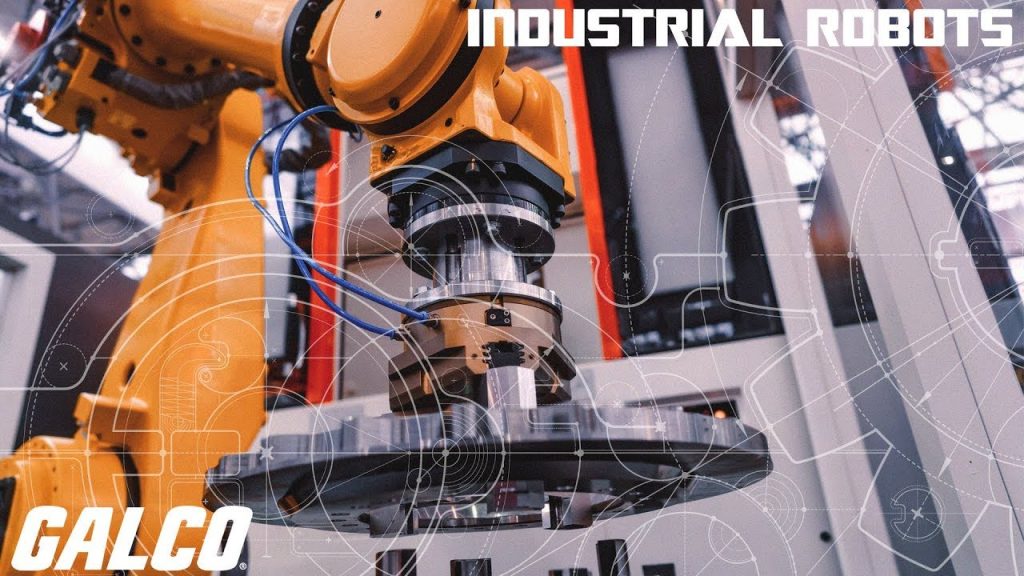
Articulated robots are perhaps the most versatile and widely used type of industrial robot. These robots have multiple rotary joints, enabling them to mimic the movements of a human arm. Articulated robots are commonly used in welding, painting, assembly, and material handling applications. Their flexibility and adaptability make them indispensable in various industries.
Now that we have explored the four most commonly used industrial robot types, let’s delve into their kinematics and applications. Each robot type has unique characteristics that determine its range of motion and capabilities. Understanding these kinematics is essential for optimizing the performance of industrial robots in various applications.
SCARA robots, with their X-Y planar motion, are ideal for tasks that require precise assembly, such as electronics manufacturing. Cartesian robots, with their linear motion along the X, Y, and Z axes, excel in material handling and pick-and-place operations. Delta robots, with their parallel arm structure, are perfect for high-speed packaging and sorting applications. Articulated robots, with their multiple rotary joints, offer exceptional flexibility and are commonly used in welding and painting processes.
In conclusion, industrial robots are revolutionizing the way we manufacture and automate processes. The four most commonly used industrial robot types – SCARA, Cartesian, Delta, and Articulated – each have their own unique kinematics and applications. Understanding these robots’ capabilities allows us to maximize efficiency and productivity in various industries.
So, if you’re looking for a professional solution for your coil packing needs, check out the leading manufacturer in the industry. They offer state-of-the-art coil packing solutions that will help optimize your production processes. Don’t miss out on the opportunity to enhance your manufacturing operations with the latest advancements in industrial robots. Industrial Robot
“Mastering the Kinematics and Types of Industrial Robots: Revolutionizing Automation”